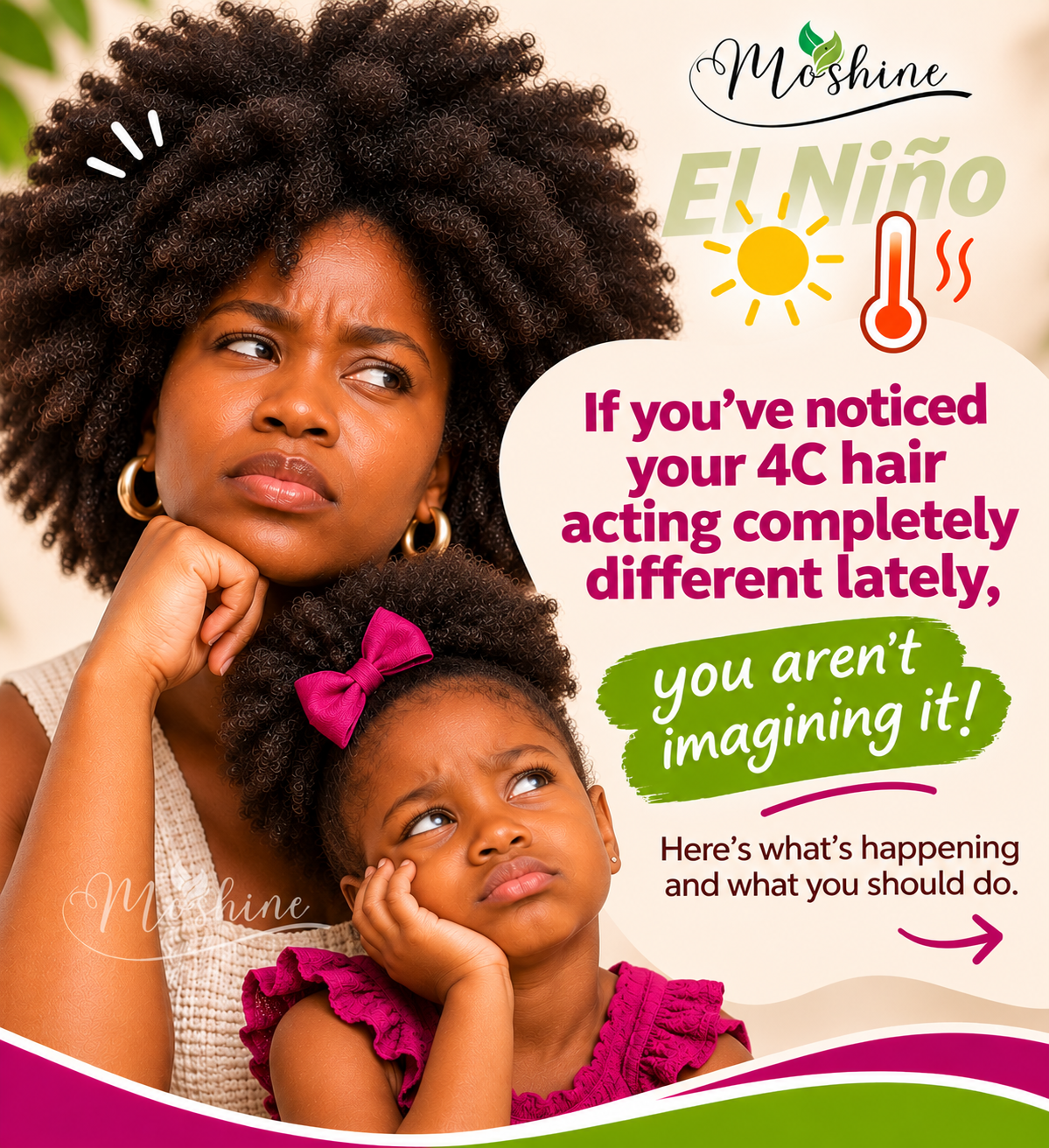
If you’ve noticed your 4C hair acting completely differently lately, you aren’t imagining it.
The combination of high temperatures and humidity can create unique challenges for tightly coiled hair. Your scalp may feel sweatier, your curls may lose definition, your hair may feel heavier from products, and your usual routine may no longer give you the results you’re accustomed to.
But what’s actually happening?
Let’s look at the science behind it and how you can adjust your haircare routine to keep your crown healthy.
What’s Happening to Your Hair Right Now?
1. The Sweaty Scalp Struggle
Hot weather means increased sweating, especially around the scalp.
When sweat mixes with natural sebum, dead skin cells, dust and leftover styling products, buildup can accumulate on the scalp.
You may begin to notice:
- A sweaty or uncomfortable scalp.
- Itching and irritation.
- Product residue around the roots.
- A scalp that feels like it needs cleansing more frequently.
This is why scalp hygiene becomes particularly important during hot weather. Don’t keep layering products onto a scalp that needs cleansing.
2. The Heat and Humidity Effect
This is where things get interesting.
Heat and humidity influence your hair in different ways.
Higher temperatures can increase evaporation from wet hair, depending on the surrounding conditions. Meanwhile, humid air contains more water vapour, which the hair fibre can absorb.
When tightly coiled hair absorbs moisture from the atmosphere, the hair shaft can swell. This affects the temporary bonds responsible for maintaining the hair’s shape and can result in:
- Increased frizz.
- Reduced curl definition.
- Hair that feels puffier or more voluminous.
- Styles that don’t hold their definition as long as usual.
So, if your beautifully defined twists or wash-and-go suddenly look different, humidity may be part of the reason.
3. The Low-Porosity Hair Surprise
Do you have low-porosity hair and suddenly feel like your usual routine isn’t working?
Don’t be surprised.
Humidity can change how your hair responds to moisture and products. Your hair may feel heavier, swell more readily or take longer to dry.
However, this doesn’t mean your hair has suddenly changed from low to high porosity. Porosity is influenced by the structure and condition of the hair fibre, while humidity affects its moisture content and behaviour.
The important thing is to observe your hair rather than relying entirely on the routine that worked in another season.
4. Pay Extra Attention to Your Ends
Have you noticed your ends snapping more often?
The ends are the oldest and most weathered parts of your hair. They are already more vulnerable to friction, tangling and mechanical damage.
Changes in moisture content can also affect the mechanical properties of hair fibres. When you combine this with frequent manipulation, detangling and friction, your ends may become more susceptible to breakage.
This is why you should pay extra attention to your ends during this period.
The Mo’shine Haircare Hot-Weather Survival Guide
Now that we understand what’s happening, how should you adjust your routine?
1. Reduce Heavy Product Layering
This may not be the season to keep piling on raw oils, heavy butters and thick creams.
Your hair still needs conditioning, but excessive product layering can leave it feeling coated, greasy and difficult to manage.
Try simplifying your routine:
- Start with a water-based leave-in conditioner.
- Apply a little lightweight oil where needed.
- If your hair needs additional conditioning, consider a lighter hydrating cream or butter.
Remember, more products don’t automatically mean more moisture.
2. Don’t Stretch Your Wash Days Unnecessarily
With increased sweating and product buildup, you may need to cleanse more frequently.
Weekly or fortnightly washing may work, depending on your scalp, lifestyle, hairstyle and product use.
If your scalp gets particularly sweaty or uncomfortable, don’t wait until your usual wash day.
Concentrate shampooing on the scalp and allow the lather to cleanse the lengths as you rinse. Avoid unnecessary rough handling of the ends.
3. Continue Deep Conditioning and Protein Care
Don’t abandon your conditioning routine because the weather is hot.
Deep conditioning helps maintain softness, manageability and conditioning of the hair fibre. Follow the recommended processing time for your particular product rather than leaving it on excessively or shortening the time without a reason.
And don’t forget protein care.
Hair needs a balance of conditioning and strengthening. Protein treatments may be useful when hair is weak, damaged, excessively stretchy or losing elasticity.
However, not everyone needs a protein treatment every four to six weeks. Choose the frequency based on your hair’s condition and the strength of the treatment you’re using.
4. Choose Comfortable, Low-Manipulation Hairstyles
This is a good time to simplify your hairstyles.
Consider:
- Loose mini twists.
- Flat twists.
- Cornrows
- Comfortable updos.
- Simple protective styles that aren’t too tight or heavy.
Avoid excessive tension and styles that make it difficult to access and cleanse your scalp.
And please, don’t fight your natural shrinkage with excessive heat styling just because your curls aren’t holding their usual definition.
5. Learn to Adjust Your Routine
One of the most important things about haircare is understanding that your routine may need adjustments.
Your hair’s needs can change with the weather, your lifestyle, the products you use and its current condition.
What works perfectly during a dry season may feel too heavy during a humid period.
Don’t be afraid to simplify, observe and adjust.
A Final Word from Mo’shine
Healthy haircare isn’t about following every trending routine or using as many products as possible.
It’s about understanding your hair, knowing what it needs and being consistent with the right practices.
This season, pay attention to your scalp, be mindful of product layering, protect your ends and choose hairstyles that make maintenance easier.
Take your time to find the routine that works best for your hair.
Mo’shine Haircare — Nurturing healthy hair at every stage.